


Estrogen Dominance (Part 4 – continuation of Part 3) – How Do You Help Your Liver Break Down Estrogen?

So much talk about estrogen lately! We discussed:
- Ovulation basics (Part 1 – click here)
- How to recognize estrogen dominance symptoms (Also Part 1 – click here)
- What causes low progesterone (Part 2 – click here) and
- How to help the liver break down estrogen! (Part 3 – click here)
… but we weren’t quite done with the last topic!
You see, the liver breaks down estrogen in 2 phases. In part 3 we talked about the first phase. In this part, I will give you tips on how to help with the second phase! If you missed the first part, just click here to read it!
When Should I Optimize Estrogen Breakdown?
If you have estrogen dominance symptoms (check this article of the series) AND it is caused by high levels of estrogen!!! Estrogen dominance can also be caused by low progesterone – which you can all read about here.
How do you know if estrogen dominance is caused by low progesterone or high estrogen?
You will have to test!
A good test is the DUTCH complete test. If your cycle is irregular, absent or if the luteal phase (see part 1 of this series!) is shifting you can choose DUTCH Cycle Mapping as an alternative. If you have doubts, just ask @Bernadette_Abraham or me.
Reminders of Part 3
To understand this part better I would like to remind you of some key points of part 3:
- Estrogen is not a hormone, it is a group of hormones: Estrone (E1), Estradiol (E2), Estriol (E3) and Estrol(E4) – but forget E4 for now!
- In the first phase, estrogen gets broken down by putting an alcohol group to it. This happens mainly at 3 different positions, depending on which liver enzyme sticks the alcohol group to the molecule. To make this article readable I like to ‘color-code‘ the 3 different pathways:
- The Green Estrogen Detox Pathway: This pathway is the one we would like to use mainly.
- The Yellow Estrogen Detox Pathway: Stimulates growth – good for bones, bad for cancerous cells.
- The Red Estrogen Detox Pathway: Increases the risk of DNA damage the most. We don’t want that.
Phase 2 Detoxification Explained Simply!
Whatever form of estrogen metabolite came out of phase 1, we don’t want to it to stay there. All phase 1 metabolites do some kind of damage. The green pathway just has the least risk of damage. We would like to quickly convert all those metabolites to a more water-soluble and less damaging form.
How does the liver do that?
By sticking a carbon group or methyl group to the estrogen metabolite.
This is called the methylation of estrogen.
The enzyme that helps add the methyl group is called COMT (or Catechol-o-methyltransferase… try to pronounce that 3 times after each other!)
How to help phase 2 detoxification?
COMT is not only involved in estrogen breakdown. It also helps break down dopamine, adrenaline (or epinephrine) and nor-adrenaline (or nor-epinephrine) for example. Some nutrients are also broken down by the COMT enzyme… like quercetin!
Not every body makes the enzyme in the same way! Some people have a gene that codes for a more efficient version, making the enzyme faster acting. Some people have a slower-acting enzyme.
If you are for example a person who needs a long time to calm down after you were scared or had a stressful talk – you might have a slow COMT. Pain and chronic stress can increase the need for COMT. In this case, you might not have a slow COMT, but a high demand for this enzyme resulting possibly in a slower phase 2 detoxification of estrogen as well.
But we can help the enzyme! Here are some ways to do that:
- Magnesium for example is a cofactor for COMT. This is partially the reason why magnesium helps to reduce stress!
- Reducing stress and anxiety makes sure your COMT is more available for breaking down estrogen.
- COMT works by using a methyl group donated by S-adenosyl methionine or SAMe for short. SAMe is a supplement!
- Zinc might be just as effective according to research.
- We do need to have a good methylation cycle (and now I am not referring to the methylation of estrogen!).Confused? Just forget it for now. I will explain the difference later! We help the methylation cycle with the following nutrients:
- We need the bioactive forms of B vitamins like methyl-folate (B9), methyl B12, and B6. We also need vitamin B2 (riboflavin) and B3(niacin).
- Choline (which is in eggs, liver, mushrooms, beef, chicken, turkey and cruciferous vegetables) can help.
- Betainewhich is a choline derivative and is found in beets, brown rice, rye grain, quinoa and sweet potato.
- Zincagain!
- Some people struggle with having an optimal methylation cycle because of genes. A lot of the end product of the methylation cycle is however creatine. Supplementing with creatine monohydrate can reduce the need for the methylation cycle.
Methylation of estrogen vs The Methylation Cycle
If you aren’t completely new to functional medicine, you might have heard of methylation before. Methylation and Methylation of estrogen are related… but they are not the same, so don’t confuse those two! With Methylation, we refer to The Methylation Pathway.
In this pathway, a methyl group is passed from methionine to homocysteine. It goes like this:
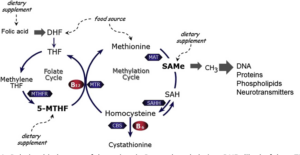
- Methionine, an amino acid found in food, donates a methyl group to SAMe (or S-adenosylmethionine). SAMe you might know as a supplement!
- SAMe is a universal methyl group donor. Once it donates its methyl group it gets converted back to homocysteine.
- Homocysteine gets a methyl group from methyl B12 – The methylated version of vitamin B12 we often talk about.
How are The Methylation Cycle & The Methylation of Estrogen related?
Well…
The methylation cycle produces SAMe which donates its methyl group to COMT. COMT then uses this methyl group to stick it to estrogen. And now estrogen is water-soluble and ready for excretion!
Here you are! Phase 2 detoxification in a nutshell!
How estrogen is excreted is the topic for Part 5 in this series!


